When Lawsuits Become Investments: How Third-Party Litigation Funding Raises Risks
When Lawsuits Become Investments: How Third-Party Litigation Funding Raises Risks
The following article is shared with permission from our colleagues at the Pennsylvania Food Merchants Association (PFMA). While it focuses on food merchants, the challenges it describes are also hitting Pennsylvania’s trucking industry hard. Motor carriers—like many other essential industries—are facing sharply rising insurance costs driven by nuclear verdicts, inflated settlements, and the growing role of third-party litigation funding (TPLF), where outside investors finance lawsuits in exchange for a share of the payout. These practices are distorting the civil justice system, driving up costs for businesses, and ultimately increasing prices for consumers. The trucking industry and other sectors that keep our economy moving have a shared interest in bringing greater transparency and balance to the litigation environment.
When Lawsuits Become Investments: How Third-Party Litigation Funding Raises Risks for Food Merchants
BY: The Seltzer Group Partners, Pennsylvania Coalition for Civil Justice Reform, and Pennsylvania Food Merchants Association.
The case of Sean Murtaugh v. Robert S. Goggin, III, Esquire, recently pending in federal court, illustrates how undisclosed third-party litigation funding can strip individuals of control over their own claims and distort the legal process in ways that ripple far beyond a single lawsuit.
Mr. Murtaugh, a lineman for Amtrak, suffered a serious workplace injury and retained legal counsel to pursue a claim. According to the complaint, when he agreed to settle in February 2023, he did so without a clear accounting of costs or a reliable estimate of his net recovery. More troubling, he was unaware that his attorney had already communicated acceptance of the settlement to the court without his authorization or informed consent.
Only after the settlement did Mr. Murtaugh learn what had been happening behind the scenes. Without his knowledge, his attorney allegedly entered into multiple third-party litigation funding agreements in Mr. Murtaugh’s name to finance case expenses. These agreements were never disclosed to him, never explained, and never authorized. The funding carried high interest rates that accrued daily and were charged against his share of the settlement.
For months, as the complaint details, Mr. Murtaugh repeatedly requested a basic accounting of costs and his final take-home amount. His inquiries were apparently met with delays, vague explanations, and inconsistent figures. When cost information was eventually provided, the complaint notes that interest charges were obscured under generic labels such as “costs” or “fees for advanced costs,” concealing both the existence and magnitude of the funding interest.
As details emerged, Mr. Murtaugh learned and then asserted that roughly $70,000 in litigation funding he never agreed to had ballooned to more than $136,000 due to interest he did not know was accruing. Although he allegedly had expert support for nearly $3 million in economic damages and was promised a substantial recovery, he ultimately received about $141,000 after fees, liens, costs, and unauthorized interest. The complaint alleges a coordinated scheme that prioritized financial returns over the interests of an injured worker who trusted his representatives to act on his behalf.
This case exposes a broader issue with growing consequences for businesses across Pennsylvania.
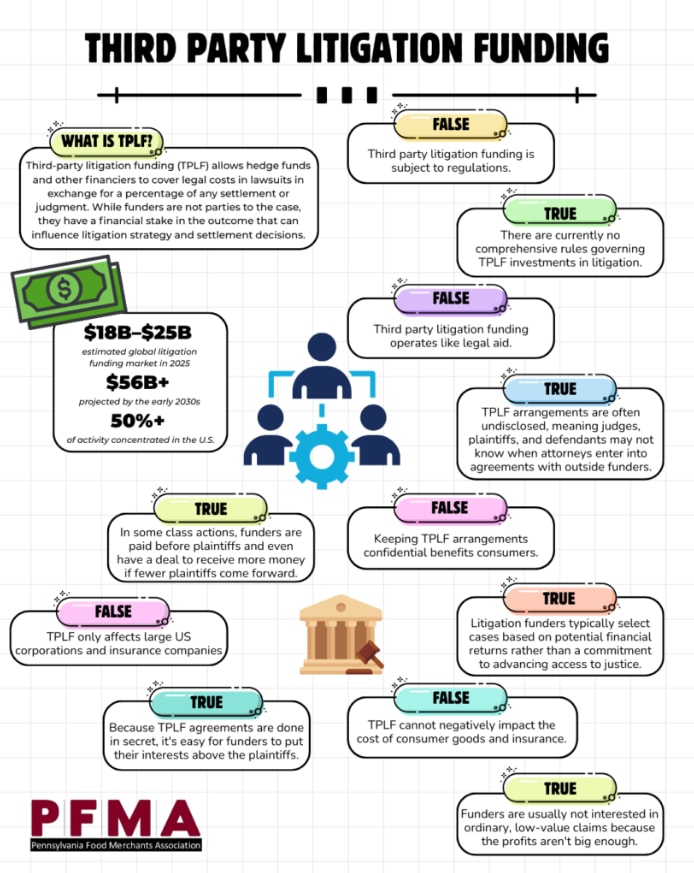
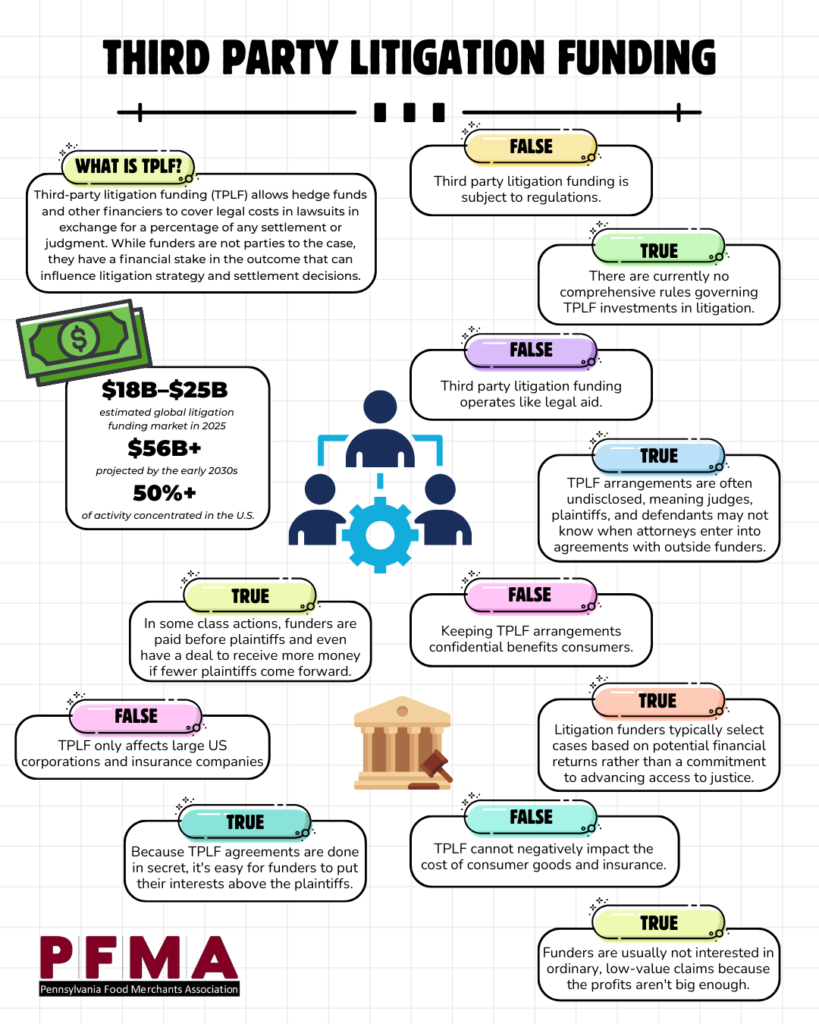
Third-party litigation funding, or TPLF, is the practice of outside investors paying legal costs in exchange for a portion of any settlement or verdict.¹ In effect, lawsuits become assets, traded and managed much like investments. Critics point out that profit-driven funding changes incentives, often encouraging longer, more aggressive, and more expensive litigation.²
An additional concern is the increasing involvement of foreign entities as litigation funders.³ Overseas hedge funds and investment groups, often operating with limited transparency, are now financing U.S. lawsuits. This raises serious questions about foreign influence over litigation strategy, settlement decisions, and access to sensitive business information disclosed during discovery.⁴
For insurers, the impact is direct. Larger settlements and prolonged litigation drive up claim costs. Those costs do not stay with insurers. They are passed downstream through higher premiums, increased deductibles, tighter underwriting standards, and reduced availability of coverage.⁵
For food and beverage businesses, the effect is magnified. Slip-and-falls, product liability claims, workers’ compensation injuries, employment disputes, and ADA allegations can be pursued more aggressively when backed by investors seeking a guaranteed return. Cases that might otherwise resolve quickly can drag on. Reasonable settlement offers become insufficient when a third-party funder needs to maximize its investment.
The result is higher insurance costs, increased uncertainty, and greater difficulty securing coverage in already liability-intensive sectors. Over time, unchecked litigation funding raises the cost of doing business, discourages investment, and places additional strain on an already burdened legal system. Ultimately, those costs are borne by employers, workers, and consumers.
Understanding third-party litigation funding helps explain why insurance costs continue to rise and why risk management matters more than ever.
PFMA encourages members to support legislative efforts calling for greater transparency and oversight of third-party litigation funding. Increased disclosure and sensible guardrails can help ensure that litigation decisions are driven by the interests of plaintiffs and the pursuit of fair resolution, not by undisclosed investors seeking maximum financial return. Transparency helps lawmakers better understand how litigation funding affects insurance markets, business costs, and consumers, and supports a legal system that remains fair, predictable, and focused on justice rather than speculation.
- Strengthen in-store safety and loss control practices
- Train managers and frontline staff on incident response and documentation protocols
- Investigate and document incidents promptly and thoroughly
- Review liability limits, deductibles, exclusions, and self-insured retentions annually
- Discuss litigation funding trends with insurance carriers and brokers during renewals
- Partner with insurance advisors focused on proactive risk management
- Engage with state legislators to share how rising litigation costs and insurance pressures affect daily operations, coverage availability, and long-term planning
- Support efforts that promote transparency and oversight in third-party litigation funding, helping policymakers understand its real-world business impacts
TPLF may operate behind the scenes, but its effects are increasingly visible on balance sheets across the Food and Beverage Industry. Rising insurance premiums, tighter coverage terms, and prolonged claims are not abstract trends, they are direct business challenges. Awareness, preparation, and engagement are essential to managing this risk, particularly as litigation funding continues to expand with limited oversight. Addressing the issue now can help prevent today’s lawsuits from becoming tomorrow’s unavoidable costs for Pennsylvania businesses and consumers alike.
Sources and References
- U.S. Government Accountability Office. Third-Party Litigation Financing: Market Characteristics, Data, and Trends. GAO-23-105210.
- U.S. Chamber of Commerce Institute for Legal Reform. Lifting the Shadows: Restating the Case for Reforming Third-Party Litigation Funding.
- U.S. Chamber of Commerce Institute for Legal Reform. ILR Briefly: A New Threat: The National Security Risk of Third Party Litigation Funding.
- Case for Consumers. It’s Time to Close the Anti-Consumer Litigation Funding Loophole.
- Insurance Business. Insurers warned TPLF could add $50B to industry costs.