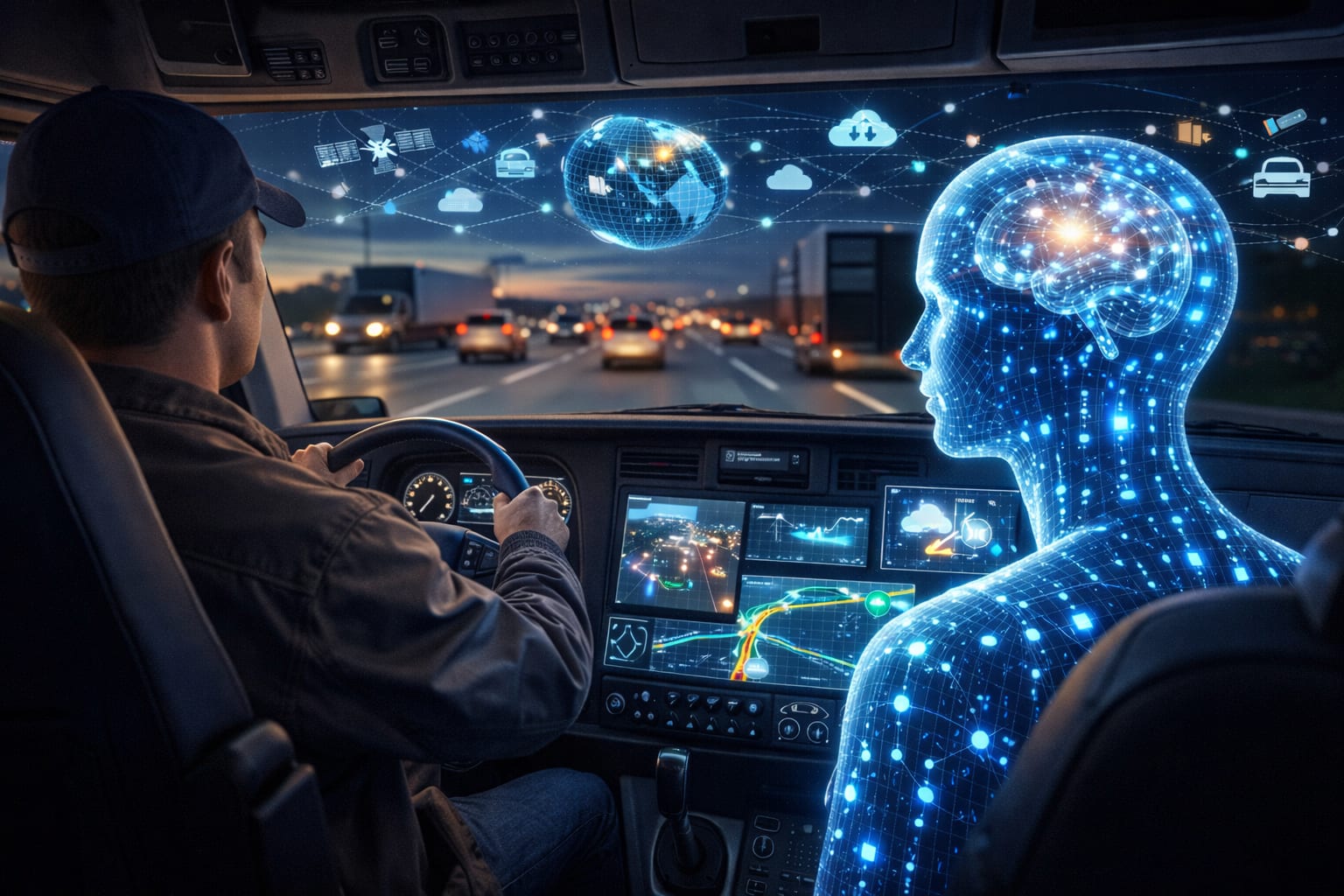
Artificial Intelligence Is Riding Shotgun
Artificial Intelligence Is Riding Shotgun
Most of us have seen the sign.
HOV Lane — Two or More Passengers.
The theory is simple: two people in the car means two brains thinking about the trip, watching the road, maybe helping navigate. At least in theory.
Now imagine something different.
Instead of one extra passenger riding along, imagine the analytical brainpower of thousands—maybe even millions—quietly sitting in the passenger seat.
No complaints about the music.
No arguments about where to stop for lunch.
And nobody asking, “Are we there yet?”
That, in many ways, is what artificial intelligence is beginning to do in trucking.
From Clipboards to Calculating Power
There was a time when trucking ran on clipboards, instincts, and the phrase, “that’s the way we’ve always done it.”
And to be fair, those tools built one of the most resilient industries in the world.
But today trucking generates an enormous amount of data.
Every truck produces information about location, speed, braking events, engine performance, fuel usage, maintenance conditions, inspection records, and hours of service. Multiply that across an entire fleet and the amount of information becomes staggering.
The challenge isn’t collecting the data anymore.
The challenge is making sense of it.
That’s where artificial intelligence enters the picture.
AI systems can analyze massive amounts of information in seconds, identifying patterns and trends that would take a human days-or weeks-to uncover.
And for anyone who has ever spent an afternoon digging through spreadsheets trying to answer one simple question, the appeal of that idea becomes pretty obvious.
A Friday Afternoon Scenario
Picture a safety manager at 4:45 on a Friday afternoon.
The phone rings.
A customer wants to know why a shipment is delayed.
A driver calls with a maintenance concern.
Someone in accounting needs fuel numbers for a report.
And management wants an update on safety trends for the month.
So the safety manager starts doing what safety managers have always done—pulling reports, opening dashboards, digging through telematics data, and trying to piece together the story.
Now imagine a different scenario.
Instead of chasing five different reports, the manager asks a system a simple question:
“Show me the biggest safety risks in our fleet this month.”
Within seconds, the system highlights patterns—locations where hard braking occurs frequently, vehicles showing early signs of maintenance issues, or operational trends that may increase risk exposure.
No magic.
Just data being analyzed faster than a human realistically could on their own.
AI as a Tool for Safety
Artificial intelligence doesn’t replace safety managers. It helps them become more effective.
In trucking, AI tools can already assist fleets by:
- Identifying risky driving behaviors across thousands of miles
- Detecting patterns in safety events and near misses
- Predicting maintenance issues before breakdowns occur
- Highlighting operational inefficiencies in routing or fuel usage
- Prioritizing driver coaching where it will have the biggest impact
Think of AI as a flashlight in a dark warehouse full of data.
The information has always been there. AI simply helps illuminate where to look.
And if we’re being honest, AI can process millions of data points in seconds—something that would take a human far longer, especially if the safety meeting gets sidetracked debating the coffee situation or whether the donuts are stale.
Where the Technology Is Heading
Telematics platforms are already beginning to integrate artificial intelligence into their systems.
For example, Geotab recently introduced an AI-powered assistant and voice interface designed to help fleet managers interact with telematics data more naturally. Instead of navigating multiple dashboards, a manager could ask a question about safety trends, vehicle performance, or operational data and receive an answer generated from the system’s analysis.
The company has also introduced upgraded telematics hardware designed to collect more detailed operational information and integrate it into these AI-driven insights.
The important takeaway isn’t the brand name.
It’s the direction the industry is moving.
Fleet technology is evolving from data collection tools into decision-support systems.
The Human Element Still (AND ALWAYS WILL) Matters
Despite all the discussion about artificial intelligence, one thing remains absolutely true.
Technology does not create a safety culture.
People do.
A computer can analyze patterns in braking events, maintenance alerts, or hours-of-service trends. But it still takes experienced professionals to interpret those patterns, work with drivers, and build an environment where safety is taken seriously.
AI may identify the patterns.
But it still takes good leadership, strong communication, and experienced safety professionals to decide what to do about them.
Think of artificial intelligence not as a replacement for people, but as a very smart co-pilot.
One that never sleeps, never complains about the radio station, and never asks for a bigger office.
What This Means for Carriers
Artificial intelligence isn’t a future concept in trucking.
In many ways, it’s already here—quietly embedded in telematics systems, analytics platforms, and fleet management tools.
The fleets that benefit the most will be the ones that recognize AI for what it really is:
A tool that helps good safety programs become even better.
Used properly, AI can help carriers operate more efficiently, identify risks sooner, protect their drivers, and make better operational decisions.
And in an industry where safety, reliability, and efficiency matter every single day, having that kind of analytical horsepower riding shotgun isn’t a bad idea at all.
Make it Safe. Make it Personal. Make it Home.